This is compilation of the articles written in CNN Money.com by Hibah Yousuf, staff reporter. Its divided into 6 section, however Financial Freedomino will compiled and published in on page.


Digging through the rubble: Best bank stocks

It's been two years since the collapse of Lehman Brothers roiled financial stocks. As banks continue to recover, here are 5 that fund managers are betting on.


Banks are back

Two years after the death of Lehman Brothers sent the financial industry into a tailspin, banks are finally emerging from the rubble and standing on their own two feet again (many with the help of a government bailout, of course).
A note of caution: The credit crisis isn't over, and new regulations requiring banks to boost their capital to be better prepared to absorb losses are still casting a shadow over future profitability.

We talked to fund managers to find out which banks they're investing in. JP Morgan Chase is an obvious favorite thanks to investors' love affair with Jamie Dimon, but click through to see which other five banks made the cut and why.


Bank of America: Cheap chic
Total deposits: $1 trillion
52-week range: $12.18 - $19.86
Bank of America's shares plunged more than 21% on Sept. 15, 2008 -- the day Lehman Brothers declared bankruptcy and the Charlotte, N.C.-based bank agreed to buy Merrill Lynch as the financial crisis intensified. In fact, Bank of America's stock sank more than 90% by the time the market bottomed in March 2009.

The stock has recovered some since then, but it suffered another hard hit this summer, when executives detailed how new Wall Street provisions -- particularly the so-called Durbin Amendment -- would impact fees that the bank collects from debit card swipes.

The pessimistic outlook initially spooked investors and drove the bank's stock price so low that it's now considered significantly undervalued, said Blake Howells, director of equity research for Becker Capital Management, which owns shares of Bank of America.

"The stock is trading at a price that is fairly cheap even by historical standards," he said. "We know Bank of America has significant exposure to regulations on debit interchange fees because it is so consumer oriented, but we think it will be able to offset the negatives with fees assessed on other product lines and additional cost-cutting measures."

With the risks already priced into the market, Howells said the stock is likely to head higher. In fact, he expects it to top $21 a share over the next few years as credit conditions normalize.


Cullen/Frost Bankers: What bailout?

Total deposits: $14 billion
52-week range: $45.67 - $60.78
Texas was among the most resilient states during the recession, so it's no surprise that San-Antonio-based Cullen/Frost Bankers was one of the banks that happily refused bailout money from Washington.

The bank's CEO, Dick Evans, recently told CNNMoney that the decision allowed Cullen/Frost to stay focused on its customers and avoid distraction from the government.

And that's a good sign for shareholders, too, said John Snyder, manager of the John Hancock Sovereign Investors fund, which owns shares of the bank.

He doesn't think any banks are home run investments due to all the uncertainties surrounding Wall Street reform, but he's a fan of those with clean balance sheets and plenty of capital like Cullen/Frost.

Those types of advantages, he said, have helped the bank consistently pay dividends to shareholders with a yield of almost 3.5%, which is likely to get healthier as the bank increases its dividend over the next few years.


City National: Hollywood glam

Total deposits: $18 billion
52-week range: $36.43 - $64.30
Known as "the bank of the stars," Beverly Hills-based City National Bank boasts a wealthy client base that provides the regional bank with a nice cushion to outlast another credit crisis.

With more than $18 billion in deposits, an extraordinary 92% of them are from customers who have non-interest-bearing accounts.

That gives City National an advantage that has helped the bank aggressively pay back the $400 million it received in government bailout funds, and take over three failed banks in the last year.

Plus, at its current price, the bank's stock is a pretty decent value, according to Jason Tyler, senior vice president and director of research operations at Ariel Capital Management, which own shares of City National. Tyler expects the bank's stock to climb almost 40% over the next two years to about $71 a share.

US Bancorp: Dividend boost

Total deposits: $191 billion
52-week range: $20.44 - $28.43
Though executives at US Bancorp, owner of US Bank, remain cautious and recently warned that the bank will wait to digest recent U.S. and global regulatory changes before increasing its dividend, investors are confident that the bank will be among the first to reward shareholders with a substantially improved payout.

The regional bank enjoys a large footprint in retail banking and has been able to maintain strong levels of profitability over the last several years, said Chris Bingaman, a portfolio manager at Diamond Hill Capital Management, which owns shares of the bank.

Bingaman added that Minneapolis-based US Bancorp is poised to gain market share as it expands its network in the 24 states where it operates and looks for opportunities to acquire other banks in those regions.

And with the recent release of Basel III rules on capital requirements, the bank is one step closer to raising its quarterly dividend from its current 5 cents per shar.


Wells Fargo: Bargain bet


Total deposits: $817 billion
52-week range: $23.02 - $34.25
Shares of Wells Fargo have slowly recovered from a 13-month low hit just three weeks ago, but the stock is still selling at a fairly generous discount.

"The stock doesn't have Wells Fargo's positive attributes priced in," said Chris Bingaman, a portfolio manager at Diamond Hill Capital Management, which owns shares of the San Francisco-based bank. He expects the stock will surge almost 50% as the credit market improves.

With a litany of financial products, healthy profit margins and a diverse geographic base, Wells Fargo is on track to consistently post strong profits, Bingaman said.

And although Wall Street reforms will weigh on some of the bank's practices, Bingaman added that Wells Fargo will be less impacted in comparison to its rivals and will likely be able to mitigate the downside by adapting and continuing to generate profit from other business lines.


For more graphical charts and others, read full article here.

Some say the easiest way to make the bank bankrupt is by asking all the depositors cashing out all their deposits at the same time.


By Chris Isidore, senior writer September 20, 2010: 12:03 PM ET


NEW YORK (CNNMoney.com) -- The Great Recession ended in June 2009, according to the body charged with dating when economic downturns begin and end. But the news comes amid rising fears of a double-dip recession.

The National Bureau of Economic Research, an independent group of economists, released a statement Monday saying economic data now clearly points to the economy turning higher last summer.

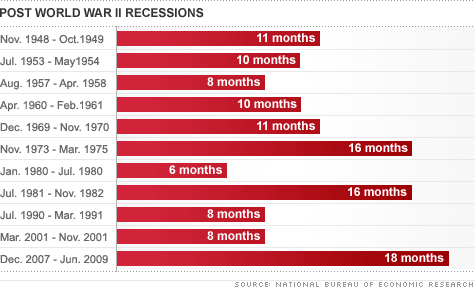
That makes the 18-month recession that started in December 2007 the longest and deepest downturn for the U.S. economy since the Great Depression.

The NBER acknowledged the risk of double-dip recession in its statement, but said "The committee decided that any future downturn of the economy would be a new recession and not a continuation of the recession that began in December 2007. The basis for this decision was the length and strength of the recovery to date."

The committee that made the finding said it "did not conclude that economic conditions since that month have been favorable or that the economy has returned to operating at normal capacity." Rather, it decided that June was when the economy hit bottom, and that it has been slowly but steadily growing since then.

"Economic activity is typically below normal in the early stages of an expansion, and it sometimes remains so well into the expansion," said the NBER.

Most economists have been saying for months that the recession likely ended in the summer of 2009.

"No, we are not still in a recession as some people have asserted," said Barry Ritholtz, CEO of Fusion IQ, a research firm based in New York. "No, it's not a depression. The wheel has turned, the trough is more than a year behind us. This is not a robust recovery, but the economy is now expanding, not contracting."

Ritholtz places the risk of a double-dip recession in the 20%-30% range. Some other economists have put the risk as high as 40%. One of those is Sung Won Sohn, economics professor at Cal State University Channel Islands. He said the NBER determination that the recession ended more than a year ago does nothing to reduce his fears of another recession looming around the corner.

"The primary reason is we don't have any cylinder powering the economy," he said. "It's hard to imagine where the strength comes from."

The NBER typically takes a long time to declare the start and end of recessions, waiting for all the economic data to be revised and finalized and making sure that any change in direction of the economy is long-lasting. It didn't declare that the recession started in December of 2007 until a year later.

In addition to looking at gross domestic product, the broadest measure of the nation's economic health, the NBER also weighs employment, industrial production, income and sales for determining when the economy changes direction.

Many of those measures have weakened in recent months, even if they are still showing modest growth. That weakening is a key factor raising fears of a double dip.

Still, double-dip recessions are relatively rare. The last one occurred in the United States when the 1980 recession was followed by another in 1981-82. The NBER waited until July 1981 to declare the end of the 1980 recession, which turned out to be the same month that it eventually determined the next recession had begun.


Resource: CNN

Hello there, we meet again. Financial Freedomino is preparing one new series to be shared together. As for the Part 1 of Preparing For Next Recession, some ideas will be listed.


Economic Recession is one of the biggest problem and mistakes face by us nowadays. Since most of us are implementing and practicing the Capitalist Model Based Economy, so we will be facing this problems later.

What is the Capitalist Model Based Economy?
Simple words, Capitalist Model Based Economy is to make sure profits keep on returning and increasing. Expecting a very high Return Of Investment (ROI). In this concept, profits will come first while other rest are all left behind.

Once the recession hit the world, we can see and heard one by one company collapse. One of the consequences is many of workers will lost their job. Without paycheck, will they survive? or CAN YOU SURVIVE IF YOU ARE ONE OF THEM?


Yes! Only if you are preparing for it!


From the latest economy recession, it can be included that:

  • The time scale for these few years of the economy recession is around 10 Years. Therefore, you will have around 8 Years to be prepared for next recession after recovering from the latest recession.

  • The latest trend is, even a country can collapsed and bankrupt. The best example is Greece. Imagine if a country bankrupt, how many major impacts can rise after that?

  • Not only small business and industries get the catastrophic, but giant, established company are also facing the problem. One of the example is, Sony. During the latest recession (2008-2010), the news reported that they have to shutdown a few investment done in other countries or even reducing the operation cost. Who say the giant can't fall?


Therefore, we will always to be prepared. The good investor will always be prepared.


As in previous article, one of the subdivision in stock investment is Blue Chip Stock. What is actually Blue Chip Stock?


Here are some definition of the term, compiled from few resources can be found in the net.


Wikipedia defines Blue Chip Stock as:

A blue chip stock is the stock of a well-established company having stable earnings and no extensive liabilities. Blue chip stocks pay regular dividends, even when business is faring worse than usual. The term is derived from casinos, where blue chips represent the greatest value among the many colors of chips.
The phrase was coined by Oliver Gingold of Dow Jones sometime in 1923 or 1924. Company folklore recounts that the term apparently got its start when Gingold was standing by the stock ticker at the brokerage firm that later became Merrill Lynch. Noticing several trades at USD$200 or USD$250 a share or more, he said to Lucien Hooper of W.E. Hutton & Co. that he intended to return to the office to "write about these blue chip stocks." Thus the phrase was born. It has been in use ever since, originally in reference to high-priced stocks, more commonly used today to refer to high-quality stocks.[1] In contemporary media, Blue Chips and their daily performances are frequently mentioned alongside other economic averages like the Dow Jones Industrial Average.


Investopedia refered Blue Chip as:

Stock of a well-established and financially sound company that has demonstrated its ability to pay dividends in both good and bad times. These stocks are usually less risky than other stocks. The stock price of a blue chip usually closely follows the S&P 500.


While About.com mentioned Blue Chip Stock as:


A "blue chip" is the nickname for a stock that is thought to be safe, in excellent financial shape and firmly entrenched as a leader in its field. Blue chips generally pay dividends and are favorably regarded by investors. A few examples of blue chips are Wal-Mart, Coca-Cola, Gillette, Berkshire Hathaway and Exxon-Mobile.
Blue chip stocks are sometimes referred to as bellwether issues.

Article Updates

Investing In Indonesia’s
Rising Emerging Economy

Indonesia is positioned to remain one of the fastest growing economies in Asia after China, India and Vietnam. Investors who wish to participate in Indonesia’s growth prospects can consider investing in Public Mutual’s Public Indonesia Select Fund (PINDOSF) which will be launched on 1 September 2010. PINDOSF provides unit trust investors with an opportunity to achieve capital growth over the medium- to long-term period by investing in a portfolio of equities listed primarily in the Indonesian market.

Indonesia has the largest economy in Southeast Asia and is a member of the G-20 group of countries. As one of the emerging economies, Indonesia charted a healthy growth averaging 5.1 percent per annum over the 2000-2009 period underpinned by resilient domestic demand and a series of economic reforms. In comparison, the ASEAN economies registered an average GDP growth of 4.6 percent1 per annum over the same period.

Indonesia’s domestic demand is supported by a large population base of around 232 million people, making it the fourth most populated country in the world after China, India and the U.S. In recent years, Indonesia’s political stability and the government’s liberalisation of the economy coupled with sound fiscal and debt management have provided a conducive environment for the country to achieve robust economic growth.


*Bloomberg Consensus Forecast, July 2010

Factors Driving Indonesia’s Economic Performance

Despite the global economic slowdown in 2009, Indonesia was one of the few countries that managed to register a positive GDP growth of 4.5 percent on the back of resilient domestic demand. Domestic demand was driven by consumer spending, which accounts for 57.4 percent of GDP, and investment spending, which represents 23.4 percent of GDP. In the first half of 2010, GDP growth rebounded by 5.9 percent with consumer spending sustained at 4.5 percent and investment spending rising by 7.9 percent. The factors that contributed to the rapid GDP growth of Indonesia are:

Healthy consumer spending: Over the 2000-2009 period, consumer spending in Indonesia grew at a healthy rate averaging 4.1 percent per annum fuelled by higher disposable incomes amidst accommodative interest rates and manageable inflationary pressures. Consumer spending has also been supported by the rising urbanisation trend with the urban population ratio rising from 42 percent2 in 2000 to 51.5 percent2 in 2008. Meanwhile, the central bank kept its reference rate, the benchmark interest rate of Indonesia, unchanged at a historical low of 6.5 percent as Indonesia’s inflation rate moderated from 10.3 percent in 2008 to 4.9 percent in 2009 and 4 percent in the first half of 2010.

Strong Foreign Direct Investments: In view of its vast opportunities, Indonesia has enjoyed rising inflows of foreign direct investments (FDI), mainly in the mining, manufacturing and transportation & communication sectors. Total FDI into Indonesia amounted to US$34.4 billion3 over the 2005-2009 period. FDI in the mining sector was driven by higher commodity prices while the transportation & communication sector benefited from increasing urbanisation trends.

Robust commodity exports: Exports have also been an important source of growth for Indonesia, accounting for 43 percent of GDP in 2009. Indonesia’s major commodity exports include oil & gas and coal which contribute 17 percent and 12 percent respectively to total exports in 2009. Meanwhile, exports of manufacturing products were driven by machinery and transportation equipment which comprise 14 percent of total exports in 2009.

Political stability and economic reforms: Indonesia’s economic growth over the 2000-2009 period was also attributed to the country’s political stability and a series of successful economic reforms. After President Susilo Bambang Yudhoyono took office in 2004, a comprehensive set of economic programs were implemented, such as creating more jobs, addressing corruption issues and increasing infrastructure investment spending. Subsequently, Indonesia’s economy grew at a respectable average growth of 5.7 percent per annum during his first term (2004-2009). This economic performance has helped President Yudhoyono to secure a second term following a decisive victory in the 2009 general elections where he garnered more than 60 percent of the votes cast. The smooth running and decisive outcome of the 2009 general elections have cemented the country’s democratic credentials, underpinning the country’s political stability and policy continuity.

Healthy fiscal position: Due to its sound fiscal and debt management, Indonesia’s fiscal position has improved in recent years. The government maintained a fiscal deficit of less than 3 percent of GDP over the 2000-2009 period. Despite the global economic slowdown in 2009, Indonesia registered a prudent fiscal deficit of 1.6 percent in 2009 compared to 0.1 percent in 2008. Meanwhile, the government’s commitment to reduce public debt resulted in the public sector debt-to-GDP ratio declining significantly from 88 percent in 2000 to 28 percent in 2009, the lowest among ASEAN countries.

Stable currency: The Indonesian Rupiah was one of the best performing Asian currencies in 2009 with a gain of 19.5 percent against the U.S. dollar due to the inflows of foreign funds. On a year to date basis to 28 July 2010, the Rupiah appreciated further by 5.3 percent against the U.S. dollar. Over the same period, the Rupiah depreciated by 2.4 percent against the Malaysian Ringgit.

The steady accumulation of foreign reserves has enhanced Indonesia’s liquidity position and serves as a buffer against potential financial crises. Foreign reserves rose from US$29.4 billion in 2000 to a record high of US$78.8 billion in July 2010 driven mainly by healthy trade surpluses and capital inflows.

Table 1: Performance of Jakarta Composite Index
*Year to date as at 28 July 2010

Economic Outlook

Due to its large domestic demand base, Indonesia’s economic performance is envisaged to be more resilient than other economies in the event of a slower global economic environment. Looking ahead, Indonesia’s GDP growth is projected to rebound from 4.5 percent in 2009 to 5.8 percent4 for 2010 and 6.2 percent4 in 2011 on the back of resilient consumer spending and investment spending as well as strong global demand for commodities.

Domestic demand is also expected to benefit from an accommodative interest rate environment amidst manageable inflationary pressures. Indonesia’s inflation rate, which is driven mainly by food prices, is projected at 4.9 percent5 for 2010 and 6 percent5 for 2011. Nonetheless, the inflation rate is expected to remain manageable in the medium term amidst a stable outlook for the Rupiah.

The overall economy is well-positioned to benefit from the positive political landscape as the re-election of President Yudhoyono coupled with the appointment of technocrats to the cabinet is expected to ensure continuity of economic reforms.

Outlook for The Indonesian Market

Indonesia’s stockmarket is the third largest among ASEAN countries with a market capitalisation of US$261 billion as at 30 June 2010.

After registering a 114.7 percent return in Ringgit terms for 2009, the Jakarta Composite Index continued to be one of the best performing regional markets with a gain of 17.5 percent on a year-to-date basis to 28 July 2010 amidst robust economic activities. From 2006 to the 28 July of 2010, the Jakarta Composite Index registered a total return of 143 percent in Ringgit terms (163 percent in Rupiah terms) or a commendable annualized return of 21.4 percent.

In terms of valuations, the prospective Price-to-Earnings (P/E) ratio of the Jakarta Composite Index (JCI) is 15.2x based on 2010 earnings and 12.7x based on 2011 earnings as at 28 July 2010, which is comparable to its 9-year average P/E ratio of 12.5x. Selected stocks listed on the Indonesia market are supported by strong corporate balance sheets, sound fundamentals and fair valuations.


1 ASEAN countries excluding Vietnam: Malaysia, Singapore, Thailand and Philippines
2 World Bank
3 Bank Indonesia
4 Bloomberg Consensus Forecast, July 2010
5 Bloomberg Consensus Forecast, August 2010


You are advised to read and understand the contents of the Prospectus of Public Indonesia Select Fund dated 1 September 2010 before investing. The prospectus has been registered with the Securities Commission who takes no responsibility for its contents, and neither should its registration be interpreted to mean that the Commission recommends the investment.

You should note that there are fees and charges involved; and that the prices of units and distribution payable, if any, may go down as well as up. Past performance of a fund is not an indication of its future performance. Applications to purchase units must come in the form of a duly completed application form referred to in and accompanying the prospectus. A copy of the prospectus can be obtained from your unit trust consultant or nearest Public Mutual branch.


For updated article visit this link


Investment Tips:

A good investor will always see chance. A good investor will also be prepared.


What is the investment products? Previously the article mention that the investment is more on planning, planning to make you richer, make money works for you to enable Financial Freedom.

In this post, the discussion will be on how to basically knowing the investment products. Firstly, what is the investment products? Generally,they can be defined as the method, way that can help you to achieve success investment.

The investment products listed here are taken from one of Robert T. Kiyosaki famous book; Guide To Investing. In one of the chapter found inside the book, he listed some of differential investments which are:

  • Stocks
  • Bonds
  • Mutual Fund
  • Real Estate
  • Insurance
  • Commodities
  • Savings
  • Collectibles
  • Hedge Funds


To make it clearer, he then divided each of the group into more subdivision.


The subdivision of stocks are:


  1. Common Stocks
  2. Preferred Stocks
  3. Stocks With Warrants
  4. Small Cap Stocks
  5. Blue Chip Stocks
  6. Convertible Stocks
  7. Technical Stocks
  8. Industrial Stock

As an extra info, one of the successful investor in the world, Warren Buffet has turned into billionaire by investing in the Blue Chip Stock Subdivision


The subdivision of Real Estates are:

  1. Single Family
  2. Commercial Office
  3. Commercial Retails
  4. Multi-Family
  5. Warehouse
  6. Industrial
  7. Raw Land
  8. Raw Land on the curb


Investing in Real Estates has been known for making people financial free by collecting the wealth via their passive income


The subdivision of mutual funds are:

  1. Index Fund
  2. Aggressive Fund
  3. Sector Fund
  4. Income Fund
  5. Closed End Fund
  6. Balanced Fund
  7. Municipal Funds
  8. Country Fund

Investing in mutual funds are much more reliable to those passive investor which are afraid of high risk. Approximately the mutual fund annual return are around 5% - 20%, depends on what subdivision you invested

The subdivision of Insurance are:

  1. Whole, Term, Variable Life
  2. Universal, Variable Universal
  3. Blended (whole and term in one policy)
  4. First, Second or last to die
  5. Used For Funding Buy-Sell Agreement
  6. Used For Executives Bonus and Deferred Compensation
  7. Used For Funding Estate taxes
  8. Used For Non Retirement Qualified benefits


The subdivision of bonds are:

  1. Government Bonds
  2. Company Bonds
  3. Islamic Bonds (Sukuk)

The average return of investment (ROI) of bonds are around 5% - 10% annually.


As can be founded here, there are so many investment products. People normally did not noticed most of the information listed above. They are usually only have information on the surfaces and lacks of the inside information. That's why to gain more, ones have to pain more; putting more effort to gain more knowledge.

By sharing all those info, perhaps people will get more views and knowledge.

What is investment?


Everyday people keep on talking about investment, investment, investment, investment and more and more and more...

The fact is, how many people do realize what is investment really is? Is there any simple word that can describe the term of investment?

If this term asked to most of people, the answer mostly will be like this:

"Investment is about investing your money in stocks, real estates or anything. When you invest, you will gain the profit"


"Investment is about getting more from what you has done. Example, if you buy a house for a value of 100k today, the value will become let say 200k in next 5 years. See, that's is investment really are"


It's not totally wrong and also totally right. Most of the statement above will instantly give a rough picture to people what is investment are.


However, the most accurate definition of the investment term is

"Investment is about planning. You are planning to gain more than what you have now. In simple words, you are planning on multiplying your income in times. The longer you live, the more you will gain. Investment is not what normal people called as stocks, real estate, mutual funds or even bonds. That's all are the rider, transport that can help you achieve your planning. What is your planning here? The planning here is what you call as investment"

This is the definition that can be found in Robert T. Kiyosaki book "Rich Dad's Guide to Investing".

To me, the term definition seems suit with what the situation are.

Well, maybe different people will have different definition. Feel free to share with the worlds.